Install Bostik's Airseal system products to achieve airtightness around window frames and achieve the first line of defence against heat loss in your home
What can I put into the gaps and joints around window frames to keep the cold out?
Why a window frame? Because this is often a weak point in the insulation of a house.
Before we answer this specific question, first some basic principles about insulation and airtightness.
A well-designed house will have sufficient insulation on all faces (roof, walls, and floor slab), and it will be designed to prevent heat from escaping. There will be a lining to prevent water from getting in. Insulating materials and air gaps (e.g. double-glazed windows) will reduce the amount of heat that can escape.
Insulation keeps things warm in winter and cool in the summer.
We all know the consequences of poor insulation. Your house will feel too cold in the winter and too warm in the summer. And then comes the electricity bill.
The problem of poor insulation becomes personal when it begins to affect your bank account!
Airtightness is the first line of defence. A good heating system will create a warm, healthy environment inside your home. The last thing you want to do with that warm air is lose it through weak points in your insulation system.
That’s where the window question comes from. Yes, you can close your windows. But if there are gaps around the edges, your home will still leak heat.
Can I insulate the gaps and joints around the frames of my double-glazed windows?
Yes, you can.
Enter the BOSTIK Airseal system, a concept that provides products on three levels of airtight construction: airtightness, thermal insulation, and driving rain tightness.
All three types of protection are equally important. The first concept, starting from the inside, is Airtightness.
You cannot leave your windows open constantly during the winter, because your heater will be working overtime to maintain a comfortable temperature. Similarly, if it’s a hot summer and you’ve got the air conditioning on, you’ll need to close the windows.
But if you have leaky window frames, shutting the windows won’t solve the whole problem. Heat will always look for a path to somewhere cooler. And wind on a winter’s day will find gaps to force cold air into your house.
If there’s a gap through which air can leak, it will find it, and it will take heat with it.
What is the best way to insulate window frames?
Bostik’s Airseal range provides you with a range of products that focus on sealing the joints around windows. This system is made to eliminate those weak points in the airtightness of your building.
BOSTIK P605 AIRSEAL FLEX FOAM is a one-component professional extremely flexible thermal- and sound-insulating polyurethane gun foam. It is the most airtight foam available on the market.
Airtightness. The first step for a healthy, warm, energy-efficient home.
How to seal window frames?
This is a summary only. Please refer to and carefully follow the installation instructions provided with the product.
BOSTIK P605 AIRSEAL FLEX FOAM
Please note the following limitations of this product:
- Not suitable for polyethylene, polypropylene, polycarbonate, polymethyl methacrylate (acrylic, Plexiglas, Perspex), Teflon, soft plastics, neoprene and bituminous substrates.
- Not suitable for permanent water load.
- Not suitable if there is insufficient moisture.
Step 1: Getting ready for application
The temperature of both the environment and the substrates must be within the range of -15 to +35 degrees Celsius. However, we recommend a range of +15 to +25 degrees Celsius.
The temperature of the canister must be within the range of +5 to +30 degrees Celsius. However, we recommend a range of +15 to +25 degrees Celsius.
Before using it, shake the canister vigorously – at least 20 times.
Step 2: Applying the foam
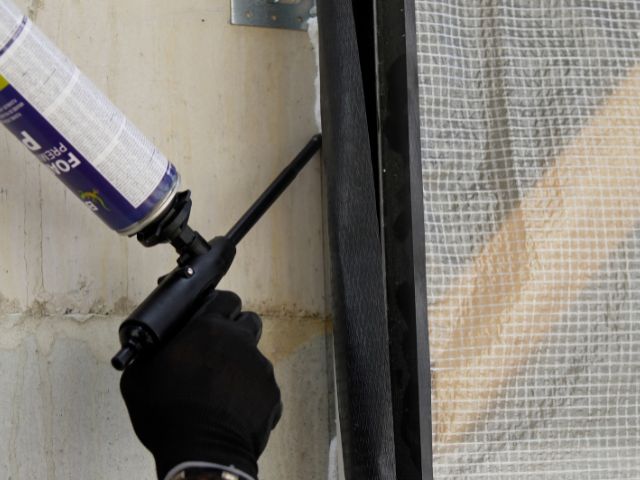
Hold the canister with the valve turned upwards and affix the adaptor on the tread. We recommend a universal PU foam gun.
Turn the canister upside down and apply the foam. To regulate the flow of the foam, loosen the valve at the back of the handle. Fill the cavity to 70% of its volume. In a low-humidity environment, lightly spray the foam with water. The foam will expand to fill the rest.
Joints wider or deeper than 4 cm should be filled in multiple layers, waiting 15 to 30 minutes between applications and lightly spraying the foam with water after each application.
Use spacers and wedges to hold the frame in place for about 24 hours, until the foam has fully cured.
Once it has cured, BOSTIK P605 AIRSEAL FLEX FOAM can be sealed or plastered over.
The Airseal System gives you airtightness, thermal insulation, and driving rain tightness. And energy savings.
Bostik's Airseal system ensures that your windows will not be a weak point in your home’s insulation system.
These airtightness products are clean and easy to use. They are flexible and will improve your home’s airtightness and thermal insulation properties. They will also improve sound insulation.
Sealing tape applied to the exterior will protect your home from water ingress. It will also act as a one-way vapour barrier that lets moisture out.
All these things add up to improved home health and comfort and, importantly, energy savings.
BOSTIK Airseal. Airtightness. Thermal Insulation. Driving rain tightness.
Related articles
Discover articles that explain, educate, and inspire for better constructions