Floor primers can be an overlooked part of floor preparation, but should be considered an essential part of any installation. If a primer for self-levelling compound isn’t used, your floor could be subject to surface imperfections, including pinholing, which could lead to costly failures further down the line.
By choosing to use a floor primer, you will enhance the bond between the self-levelling compound and the subfloor, and create a barrier to stop air escaping, which means the self-levelling compound can cure correctly.
Why do I need a primer for self-levelling compound?
Most subfloors will benefit from the application of a floor primer to reduce the risk of surface imperfections, such as pinholing.
Pinholes are tiny holes that appear on the surface of a self-levelling compound, particularly when applying to absorbent substrates, such as sand and cement screeds.
Absorbent substrates contain air, which will try to rise upwards when a self-levelling compound is applied and the liquid moves into pores in the substrate. The air is displaced from the porous substrate and will appear as air bubbles in the wet compound.
On very absorbent substrates, or substrates that have been insufficiently primed, there is a risk that the bubbles will remain and form pinholes in the hardened surface due to the “suction” from the substrate.
Besides affecting the appearance of the self-levelling compound, pinholing can also compromise the structural integrity of the floor, which can lead to costly failures.
What does floor primer do?
A floor primer will address any shortcoming in a substrate's porosity, helping to maximise a self-levelling compound’s flow and strength development, and minimise the formation of pinholes.
When applied undiluted, a floor primer also acts as a bonding agent on non-porous surfaces - such as power floated concrete, ceramic tiles, quarry tiles, rigid metal, terrazzo, asphalt and surface membranes – which can greatly improve the adhesion of self-levelling compounds to subfloors.
Step-by-step: how to apply a primer for self-levelling compound
For the best results, ensure the subfloor is clean and free from dust or any other contaminants.
If the subfloor contains residual moisture with a reading of 75% RH or above, a liquid DPM should be used.
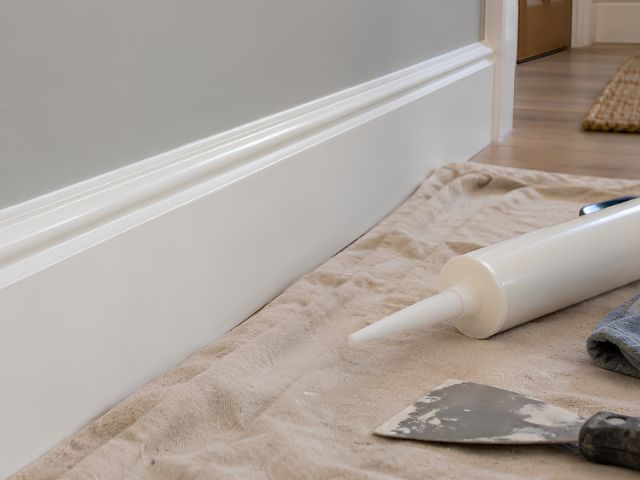
If skirting boards can’t be removed, protect them with masking tape.
- Shake the floor primer well before use and pour the product into a mixing tray.
- Apply around the edge of the room using a paintbrush. For larger areas, use a short pile roller.
- Bostik Cempolay Universal Primer can be applied neat or diluted depending on the porosity of the surface you are applying it on to – check the Technical Data Sheet for dilution rates.
- On very porous surfaces, a second coat may be required.
- The primer is a distinctive turquoise colour to assist with a uniform application.
- A self-levelling compound can be applied as soon as the primed surface is dry – this should be within one hour in good drying conditions.
WATCH VIDEO
Everything you need to know when choosing a primer for self-levelling compound
Now that you know why a floor primer is an important part of subfloor preparation, here we look at some of the frequently asked questions when it comes to applying a floor primer.
You can test the substrate's porosity with a water-drop test. Pour a small amount of water onto the subfloor. The longer it takes for the floor to absorb the water droplet, the less porous the floor.
The level of absorbency will determine the primer to be used and whether it should be used diluted or undiluted.
This will depend on the floor primer being used. Bostik Cempolay Universal Primer will dry within one hour under good conditions - typically 20°C+ and 60% RH. All water-based flooring products will be affected by cold and damp conditions, yet drying times can be reduced with good ventilation, low ambient humidity and moderate heat.
However, you should avoid using heaters that produce water vapour, such as fuel burning space heaters, as these will slow down the floor primer’s drying rate.
Bostik Cempolay Universal Primer
A water-based, solvent-free, acrylic dispersion floor primer and bonding agent that’s suitable for use prior to the application of any Bostik self-levelling compound.
When applied undiluted, it acts as a bonding agent on non-porous surfaces such as power floated concrete, ceramic tiles, quarry tiles, rigid metal, terrazzo, asphalt and surface membranes. In diluted form, Bostik Cempolay Universal Primer can be used as a primer on porous surfaces and will dry within one hour depending on the conditions.
Yes, you can. For a fast-track installation that allows you to install new floor coverings in as little as 4 hours, we offer the following system:
Bostik Cempolatex Moisture Suppressant
A ready-to-use, water based, single part surface membrane for cementitious floors. Two coats will provide protection up to 95% RH and the container is resealable and reusable.
Bostik Cempolay Universal Primer
A water-based, solvent-free, acrylic dispersion floor primer and bonding agent that’s suitable for use prior to the application of any Bostik self-levelling compound.
When applied undiluted, it acts as a bonding agent on non-porous surfaces such as power floated concrete, ceramic tiles, quarry tiles, rigid metal, terrazzo, asphalt and surface membranes. In diluted form, Bostik Cempolay Universal Primer can be used as a primer on porous surfaces and will dry within one hour depending on the conditions.
Bostik Cempolatex Rapid 30
A high strength, quick-drying self-levelling compound with a walk on time of just 30 minutes. It will smooth sound, uneven surfaces prior to the laying of decorative floor coverings. It is also suitable for use with underfloor heating. Accepts loose lay floor coverings and bonded tiles from 45 minutes, accepts other bonded floor coverings from 3 hours.
Watch our video for our top tips for a fast-track flooring installation.
You will need to assess how porous your subfloor is to determine how much floor primer you will need.
Floor primer can be used in its undiluted form on any non-porous subfloor, but on more porous substrates, it should be diluted in a ratio of 1:2 with clean water.
A 2.5L unit of floor primer will provide approximate coverage of 37.5-50m² in undiluted form, and 60-75m² when diluted.
Selecting the right floor primer depends on your specific needs and flooring material. Always follow the instructions of the chosen primer.
In undiluted form, it can be used on all smooth and dense substrates, and non-porous substrates, including power floated concrete, calcium sulphate-based screeds, mastic asphalt, firmly bonded unglazed ceramic tiles, terrazzo & quarry tiles, rigid metal ,and surface membranes.
In diluted form (1:2 with cold clean water), it can be used on porous substrates, including concrete, sand/cement screeds and flooring grade plywood. Remember that using the wrong primer can lead to poor adhesion and surface defects. Our Bostik Cempolay Universal Primer is a water-based, solvent-free, acrylic dispersion primer/bonding agent, it works effectively across all substrate types, making it a versatile choice for your flooring project and can be used on substrates containing warm water underfloor heating systems.
The drying time of floor primers varies depending on the primer, how absorbent the subfloor is, and the ambient temperature and humidity. However, it will generally dry within one hour under good drying conditions. Your primer should feel dry and tack-free to touch before applying a self-levelling compound.
Related articles
Stay aware about our latest innovation and our latest news and sponsoring actions