Low modulus sealants support joint durability in façade and structural applications. They help absorb movement between materials without cracking or detachment. Architects working on long-term projects rely on sealants that combine flexibility with resistance to weather and stress. This article explains when to specify low modulus formulations, how they perform in construction joints, and what technical properties support reliable results.
Understanding joint movement in construction
Movement joints are designed to manage shifts caused by temperature variation, material shrinkage, structural loading or environmental pressure. These joints help prevent deformation by providing space for controlled displacement. The amount of movement depends on the size of the structure, material types, and external conditions such as heat or moisture.
In façades and floors, movement can affect surface finishes, joint lines, and bonding quality. Without a suitable sealant, stress builds at the interface and may lead to failure. Selecting a solution that supports flexibility across materials and joint widths is part of ensuring project durability.
Why modulus matters: high vs low modulus sealants
Modulus describes how a sealant resists deformation under stress. A high modulus product stiffens under pressure, while a low modulus sealant stretches more easily and returns to shape without cracking. This flexibility makes low modulus options more suitable for movement joints in exposed areas.
In construction, joint sealants must accommodate expansion and contraction between materials such as concrete, brick, or aluminum. A low modulus sealant limits stress at the bond line and helps prevent adhesive failure and damage to adjacent materials. Modulus selection has a direct impact on long-term performance and surface integrity in joints subject to movement.
Material compatibility and facade performance
Sealants used in façades must perform across multiple substrates. These include concrete, brickwork, painted surfaces, metals, and some plastics. A low modulus sealant adapts to material differences without causing stress at the joint.
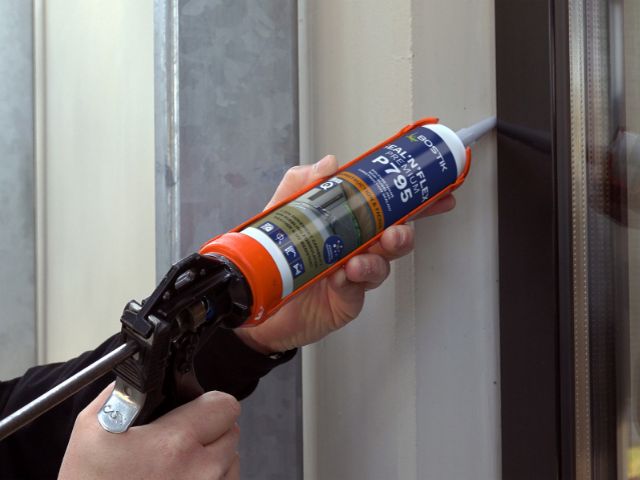
Bostik H725 SEAL’N’FLEX FAÇADE adheres without primer on most substrates, including slightly damp surfaces, supporting reliable application under variable site conditions. Bostik P590 SEAL’N’FLEX ONE PLUS offers excellent adhesion on many common building materials and can be used on many porous substrates without primer in standard conditions, though primer is recommended for critical or high-exposure applications. In façade applications exposed to weather, moisture and mechanical stress, correct sealant selection contributes to long-term joint durability and surface integrity.
Which specs to look for in a low modulus sealant
Sealants used in movement joints must maintain elasticity and adhesion throughout expansion and contraction cycles. A movement capability of 25% under EN 15651 classification (F-EXT-INT-CC 25LM / PW-EXT-INT-CC 25LM) 1, confirms suitability for façade and pedestrian applications exposed to repeated movement. ASTM C920 classification 2 further defines performance in terms of joint type, grade and use category.
Elongation at break, measured according to ISO 8339 3, is another key indicator of flexibility. H725 SEAL’N’FLEX FAÇADE provides an elongation at break of 600%, while P590 SEAL’N’FLEX ONE PLUS exceeds 1000%, supporting performance under higher deformation. Environmental and emission certifications may also be relevant depending on project requirements. H725 is certified Emicode EC1 Plus 4 and A+ (French VOC regulation) 5, supporting indoor air quality and sustainability targets, while P590 carries an A+ VOC classification.
|
1 EN 15651 (F-EXT-INT-CC 25LM / PW-EXT-INT-CC 25LM) |
2 ASTM C920 | 3 ISO 8339 | 4 EC1 Plus | 5 A+ |
|---|---|---|---|---|
|
European standard for sealants used in building construction. It classifies products according to application area and movement capability for façade, glazing, sanitary and pedestrian joints.
|
American standard specification for elastomeric joint sealants. It defines performance requirements including movement capability, adhesion, durability, and use categories (type, grade, use). |
International test method for determining tensile properties of sealants. It measures elongation at break, tensile strength, and modulus under controlled laboratory conditions. | Independent certification confirming very low VOC emissions. Often required for projects with strict indoor air quality criteria. | French emission classification system for construction products used indoors. A+ represents the highest level of low-emission performance. |
When to choose H725 or P590
H725 SEAL’N’FLEX FAÇADE is a hybrid-based, low modulus sealant developed for construction and expansion joints in façades and pedestrian walkways. It offers excellent toolability, permanent elasticity, and resistance to moisture and weathering. Movement capability is classified as 25LM 6 under EN 15651 1. The product adheres without primer on most substrates, including slightly damp surfaces, and meets several recognized standards, including Emicode EC1 Plus, ASTM C920 Class 50, and SNJF F25E 7.
P590 SEAL’N’FLEX ONE PLUS is a low modulus polyurethane sealant designed for connection and expansion joints on a wide range of building materials, including concrete, metal, aluminum, PVC, and natural stone. It features extremely high elasticity, strong UV resistance, and durable performance under external exposure. The product achieves an elongation at break greater than 1000% and supports 25% joint movement in accordance with ISO 11600 classification 8, making it suitable for applications where high flexibility is required.
| 6 25LM | 7 SNJF F25E | 8 ISO 11600 |
|---|---|---|
| Movement class indicating the sealant can accommodate ±25% joint movement. LM stands for low modulus, meaning the product deforms easily under stress while maintaining adhesion. | French certification for façade sealants. It verifies suitability for exterior joints with defined movement capability and durability requirements. | International classification standard for building sealants. It defines movement capability and modulus category (e.g., 25LM) based on standardized performance testing. |
Design smarter with movement in mind
Sealant selection influences joint performance throughout a building’s lifecycle. Low modulus formulations allow controlled movement between substrates while maintaining a durable seal.
In façade design, where joint width, material variation and environmental exposure must be managed, products such as H725 SEAL’N’FLEX FAÇADE and P590 SEAL’N’FLEX ONE PLUS provide elastic performance suited to movement joints. By specifying sealants according to verified movement capability, elasticity and certification requirements, installers can reduce long-term maintenance risks and support reliable façade performance.
Explore further application guidance and technical resources via Bostik Academy.
Related articles
Discover articles that explain, educate, and inspire for better constructions