Sealing around windows frames affects the airtightness of the entire building. A weak joint between the frame and the wall creates paths for air leaks and energy loss. The right system avoids callbacks and speeds up work on site. Bostik P605 Airseal Flexfoam supports a compact approach to insulation. It works fast, bonds to most substrates, and delivers proven airtightness in cold or damp conditions.
The architectural challenge: Maintaining performance at the window junction
In every building envelope, the window-to-wall connection remains a sensitive area. Even when high-performance glazing and insulated frames are used, the surrounding junction can still become a source of air leakage if not detailed correctly. This area often requires careful attention to ensure the designed energy performance is maintained once the building is in use.
These junctions must accommodate structural movement, resist water penetration, and remain airtight over time. At the same time, they need to align with increasingly demanding energy regulations and design targets in low-energy buildings. Solutions must deliver consistent performance, integrate easily into standard details, and be supported by clear technical documentation. Bostik products that work for this are the Bostik T660 Airseal Window Tape Duo and the Bostik T665 Airseal Window Tape Duo Plus.
The system solution: Combining window tape and foam insulation
Reliable window sealing uses products that work side by side as part of the Airseal system. The tapes provide an airtight interior seal and protect against driving rain on the exterior, while remaining open to water vapour diffusion. When installed inside the building, they can also support a vapour-permeable interior seal concept, helping manage moisture while maintaining airtightness. The tapes block air leaks and protect the joint from moisture, while Bostik P605 Airseal Flexfoam fills the cavity around the frame and helps insulate the connection between the wall and the window.
Together, the tape and foam form a continuous barrier. The joint remains airtight even as the building settles or moves over time. This method improves thermal performance and helps maintain indoor comfort. In addition, the tapes allow us to control the amount of moisture that can pass into the structure of a building. The full system supports energy performance goals and integrates easily into standard construction details, helping reduce complexity on site.
Example application: The Bostik Airseal system
The Bostik Airseal system pairs two products that meet high performance requirements for window junctions. Bostik T660 Airseal Window Tape Duo Plus and Bostik T665 Airseal Window Tape Duo Plus provide the exterior and interior seal. These tapes adapt to changing humidity and fit into designs that require airtightness, weather protection, and flexibility. The adhesive holds firmly on most materials found on site without the need of a primer, including brick and concrete. Even at low temperatures. The tapes can be painted or plastered and remain functional in variable temperatures. The Bostik T665 Airseal Window Tape Duo Plus stands out with its additional adhesive stripe, to make installation of the tape even faster and easier.
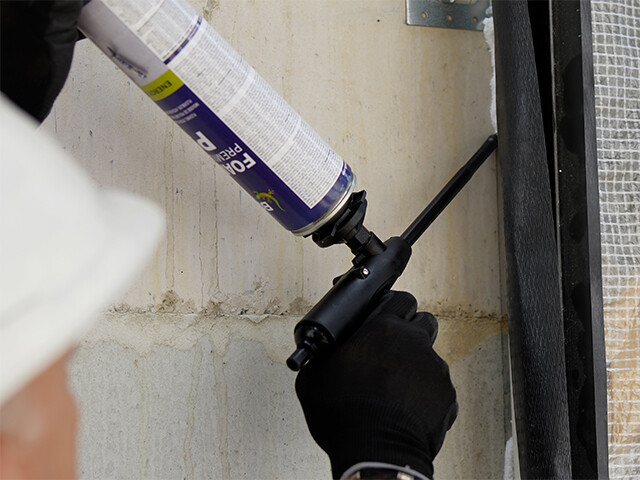
Bostik P605 Airseal Flexfoam is applied in the cavity between the frame and the wall. It expands to insulate and complements the tape by insulating the cavity. This foam achieves excellent airtightness and sound insulation values. It performs well in passive house projects and construction where energy loss must be kept low.
Using these two products together creates a continuous, airtight layer around the window. The result meets technical requirements and fits into standard construction practice. The system reduces uncertainty at a critical detail and simplifies compliance.
Compliance and performance proof: What architects expect
Documented results demonstrate the Airseal system’s performance across airtightness, thermal insulation, and water resistance. T660 and T665 tapes comply with EN 13501 1 for fire classification and EN 1027 2 for driving rain resistance. Bostik P605 Airseal Flex Foam delivers proven results for air loss, thermal conductivity, and sound insulation, confirmed at pressures up to 1050 Pa 3.
Each product includes technical data sheets with test results. This makes the system easy to include in specifications and ensures alignment with energy targets and local regulations. It fits into detailing for passive buildings and other high-performance designs.
The installation process follows standard site practices. Products are ready to use and work with widely used construction substrates such as concrete, brick, wood, and metal, which helps reduce complexity during installation.
|
1 EN 13501 |
2 EN 1027 |
3 1050 Pa pressure resistance |
|---|---|---|
| European standard for fire classification products. It defines reaction-to-fire performance for materials used in building envelopes and façades. | European test method for watertightness under driving rain. It evaluates resistance to water penetration under simulated wind pressure conditions. | Pascal (Pa) is a unit of pressure. A value of 1050 Pa represents high wind load conditions used in building envelope testing to verify airtightness under stress. |
Towards more sustainable design and simplified specification
Design teams face growing pressure to deliver energy performance, durability, and environmental responsibility. The Airseal system supports these goals with a solution that limits heat loss and improves building airtightness.
The system helps avoid unnecessary detailing. It connects with common junction types and meets thermal and acoustic expectations without introducing additional layers. By using tested components together, teams can reduce the number of variables at the frame connection and align with project targets from the early design stage.
Explore further application guidance and technical resources via Bostik Academy.




Related articles
Discover articles that explain, educate, and inspire for better constructions