Between Innovation and Tradition
What are your educational background?
Joe Harris: I have a Bachelor's degree in Business Administration and a Master's degree in Organizational Development and Strategic Leadership from Saint Joseph's University in Philadelphia, Pennsylvania.
Can you summarize your career path leading up to your current position?
J.H.: Before joining Bostik, I worked as an industrial electrician for various contractors, then in the engineering department of a healthcare organization. I started working for Bostik in 1997 at the Huntingdon Valley plant in Pennsylvania, where I managed the maintenance department.
In 2001, Bostik acquired the Paulsboro site, which became part of Bostik's Consumer and Construction Division. I became Director of Operations in 2001 before being appointed Plant Manager in 2012.
For two years, I oversaw both the Paulsboro and Baltimore, Maryland sites. Today, I am solely dedicated to running the Paulsboro unit. I am responsible for the site’s overall performance in terms of safety, quality, productivity, costs, and personnel management. I also oversee investment projects and work on continuous improvement initiatives.
“At Paulsboro plant we manufacture adhesives used in the installation of floor and wall coverings.”
J. H.: We manufacture adhesives for the flooring and wall covering industry (ceramic tiles, mortars, colored grouts, self-leveling underlayments, primers, and water-based adhesives).
The site employs 40 people. We all know each other and see each other almost every day. It's like a small family. We work in two shifts, five days a week. We have produced 45,000 tons of products. We plan to manufacture 48,000 tons in 2026. Our main customers are distributors across the United States, with a few retail customers in certain regions. My main goal is to ensure that everyone has the tools and training they need to work safely and be successful every day. We operate in a competitive market and must focus on employee retention and improving efficiency across the site to meet customer demand.
You are a “small” production unit. Does that limit your ambitions?
J. H.: Absolutely not! In fact, we are a medium-sized plant within the Arkema Adhesives segment. And for us, no project is minor! We strive to improve every year by focusing on initiatives related to safety, quality, productivity, customer service, and cost reduction. I would like to highlight our excellent safety record: 3.5 years without a single accident. I should also mention that in 2020, we invested $12 million to build a new building on site and fully automate a dosing and packaging process. We are currently completing a $2.5 million project to improve efficiency and eliminate manual handling. This is a huge improvement for our operators.
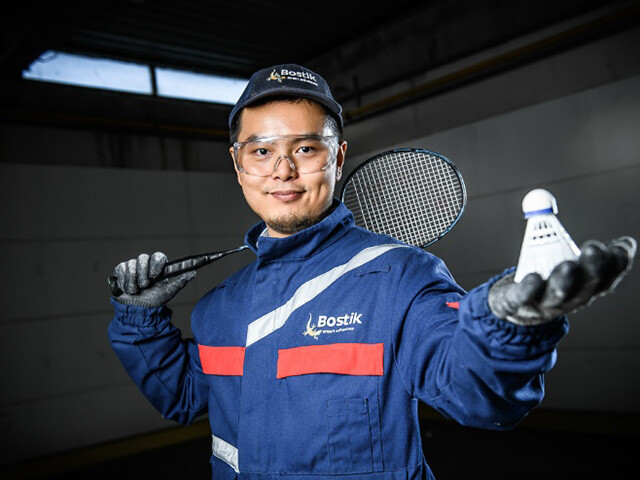
📸 In the picture: Josh Galante is a production operator. He received a Gecko Award for volunteering to work several weeks on the night shift to ensure that production deadlines were met and customer demand was satisfied.
Mummers Parade: Philly’s identity
Before we talk about your passion, tell us a little bit about yourself...
J. H.: I'm originally from Philadelphia, Pennsylvania. The city has a population of nearly 1.6 million—almost 6 million in its metropolitan area—making it the sixth most populous city in the United States! “Philly,” as it's known here, is also known as the “City of Brotherly Love.”
I currently live in West Deptford, New Jersey, about 15 minutes from the Paulsboro site. I really enjoy living in this area. I appreciate the changing seasons. However, the older I get, the longer the winters seem, and I'm ready for milder temperatures (laughs)!
Philadelphia is the scene of a unique cultural event: the Mummers Parade. What is it?
J.H.: It is the oldest folk parade in the United States.
The first edition officially took place in 1901 to celebrate the New Year.
The parade has evolved over the years. It is now a competition between several “clubs” in different categories. The city has more than 40 clubs divided into five divisions, each with its own artistic specialty: the Comics, the Wench Brigades, the Fancies, and the String Bands, of which our club is a part. Each club has four and a half minutes to present a theme. These are real mini-shows, with colorful costumes and sets, and lively dances to the sounds of cheerful marching bands. The participants are amateurs and train throughout the year to improve the quality of their performances.
What is “mumming”?
The mummers’ tradition has its origins in the Middle Ages, blending French, English, and Germanic influences. As early as the 13th century, costumed troupes began appearing in Europe; during the winter, they would travel through villages, homes, and pubs to perform, dance, or tell short skits, often in exchange for a donation. These traditions, which were widespread in Ireland, England, and Scandinavia, were later brought to North America by the first settlers. In Philadelphia, these traditions took root as early as the 18th century, when masked groups paraded on New Year’s Day. On that day, thousands of participants in elaborate costumes march with fanfare and in choreographed formations along Broad Street. Deeply rooted in Philadelphia’s identity, the parade is one of the oldest American folk traditions.
“My grandfather, my father, myself, and now my son have all taken part in the Mummers Parade.”
How long have you been participating in the Mummers Parade?
J. H.: I'm 56 years old.I was 4 when I did my first parade. Do the math (laughs)! 52 times, wow! For me, as for most Mummers, it's a family tradition passed down from generation to generation. My grandfather, my father, myself, and now my son have all participated in the Mummers Parade.
In addition to being deeply attached to this wonderful tradition, I love playing music and entertaining people. Beyond New Year's Day, we perform throughout the year in parades, festivals, and concerts.
What does the Mummers Parade mean to Philadelphia?
J.H.: Without a doubt, it's an important part of our city's history, but also its future. It brings together people of all ages and communities to celebrate both New Year's Day and our cultures and talents.
They are what make Philly a unique and diverse city. I try in my own way to perpetuate this tradition that has been embodied in my family for decades. With them and all our friends, whether they are supporters or Mummers, as is the case at our Paulsboro factory, we share the pleasure of playing music, performing on stage, and cheering on the parade.
“An important part of Philadelphia’s history but also its future.”
What are your fondest memories of the parades you've participated in?
J. H.: I'm lucky to have paraded alongside my grandfather, my father, and my son (in the photos above)! In fact, in 2019, the year my son's first parade, our club won first prize in our category!
It's a moment I'll never forget. My club has also had the opportunity to travel throughout the United States, as well as to Canada, England, Ireland, France, Italy, Spain, and Hong Kong to participate in parades and music festivals.
Tell us about your Mummers club...
J. H.: I am a member of the Quaker City String Band, which was founded in 1921 and holds the record for the most first prizes in the String Band division. Every year, our theme has to be different. We have been clowns, gold miners, movie monsters, Vikings, to name a few. The music, presentations, and costumes change every year. We hire a professional music arranger, choreographer, and costume designer. All these elements come together to make our parade as spectacular and enjoyable as possible for spectators, judges, and participants.
Does music play an important role in the parade?
J. H.: Music is essential, and I am very happy to add my own personal touch by playing the saxophone. I also play the bass violin, an instrument slightly larger than a cello, which had its heyday during the Baroque period. I have even repaired and restored a few. Coming back to the parade, we play a wide variety of tunes, including Mummers standards such as “Oh, Dem Golden Slippers” which has become an iconic Philadelphia tune. We play everything from sing-along songs to classical music, pop, Dixieland, jazz, and rock. Without being pretentious, our club produces a sound like no other (laughs)! And apparently, the audience likes it.
We strive to get everyone involved and have a good time, whether it's singing, dancing, or both!
In addition to playing with the String Band, I'm part of a group of four musicians who perform throughout the year in bars, at parties and fundraisers, as well as volunteering in hospitals and retirement homes.
A Mexican club, the San Mateo Carnavalero, has been invited to participate in the Mummers Parade in 2025. What does this mean to you?
J. H.: It's very important to me and to the Mummers community that new clubs representing other cultures participate in the parade. The Mummers Parade has changed a lot in recent years. This is what allows us to perpetuate the tradition while renewing it to continue making it a great popular event, filled with joy, in a spirit of fantastic sharing.